
There has been something going on here for the past few weeks.
I've tried to be informed on both sides. I understand both sides to some
extent. One thing I know without a doubt is that Mauna Kea is
a very special place.
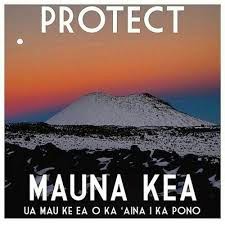
I've always had a feeling about the Big Island.
It starts as soon as Mauna Kea is seen from the airplane window.
I've driven around the island and had that feeling. Tomorrow
when I go to Hilo, I'm sure I'll have that feeling again.
I found an article that explained exactly why Mauna Kea is
so special.
THE SACREDNESS OF MAUNA KEA EXPLAINED
We pored over historical references, oral histories, testimonies and archaeological reports to help give you a better understanding of the profound reverence given to the wahi kapu (sacred place) of Mauna Kea. A shield volcano rising to 13,796 feet, it’s one of the most prominent landforms in Hawai‘i, but the sacredness of the mauna in Hawaiian culture goes far deeper than its physical features.

Mauna Kea as seen from Mauna Loa.
Photo by Windy McElroy
Genealogy
In Hawaiian traditions of creation, the earth mother Papahānaumoku and the sky father Wākea created the islands, with Hawai‘i Island being the first. “Mauna Kea is considered to be kupuna (elder), the first born, and is held in high esteem. In native traditions, Mauna Kea is identified as ‘Ka Mauna a Wākea’ (The Mountain of Wākea —traditional god and father of Hawai‘i—who’s name is also written as Kea),” described Pualani Kanaka‘ole Kanahele in a 1999 oral history study by Kumu Pono Associates. Because Mauna Kea was the firstborn child of Papa and Wākea, the mauna is considered the piko (navel) of Hawai‘i Island. The reference of Ka Mauna a Wākea is also seen in mele hānau (birth chants), like this one for Kauikeaouli (Kamehameha III) as written in the book, “The Echo of Our Song: Chants and Poems of the Hawaiians”:
O hānau ka mauna a Kea, (Born of Kea was the mountain,)
‘Ōpu‘u a‘e ka mauna a Kea. (The mountain of Kea budded forth.)
‘O Wākea ke kāne, ‘o Papa, (Wakea was the husband, Papa)
‘o Walinu‘u ka wahine, (Walinu‘u was the wife.)
Hānau Ho ‘ohoku he wahine, (Born was Ho‘ohoku, a daughter,)
Hānau Hāloa he ali‘i, (Born was Hāloa, a chief,)
Hānau ka mauna, he keiki mauna na Kea… (Born was the mountain, a mountain-son of Kea…)
‘Ōpu‘u a‘e ka mauna a Kea. (The mountain of Kea budded forth.)
‘O Wākea ke kāne, ‘o Papa, (Wakea was the husband, Papa)
‘o Walinu‘u ka wahine, (Walinu‘u was the wife.)
Hānau Ho ‘ohoku he wahine, (Born was Ho‘ohoku, a daughter,)
Hānau Hāloa he ali‘i, (Born was Hāloa, a chief,)
Hānau ka mauna, he keiki mauna na Kea… (Born was the mountain, a mountain-son of Kea…)

Lake Waiau
The water of Waiau is associated with the god Kāne, and it’s been documented that its water is used in ongoing practices by native healers. Its water is collected, used for ceremonies and for healing. In 1881, Queen Emma visited Waiau and swam across its waters “on a journey of spiritual and physical well-being.” Interviews have also been conducted with residents who reported that it was a practice to take a child’s piko (or umbilical cord) to Waiau.
Burials
In the uppermost zones of Mauna Kea, one pu‘u, or cinder cone, has been confirmed to contain burials—Pu‘u Mākanaka, which literally means “hill crowded with people.” Four other pu‘u are also considered likely to contain burials. Oral histories passed down through families have also shared that there are burials on the slopes of Mauna Kea. Alexander Kanani‘alika Lancaster in the 1999 oral history report by Kumu Pono Associates mentions that he went up the mountain “for ceremonial. They go up there bless the whole mountain for all our ancestors who’s buried up there… the old folks always said, ‘Our family is up there.’”
Piko deposition also occurs in the form of a burial on Mauna Kea, and it’s become a practice for some people to scatter the cremated remains of loved ones on the mountain.

An isolated "marae" on the western edge of the 13,000-foot plateau looks down onto the Hāmākua coast, Waimea plains, Kohala mountains and across to Haleakalā on Maui.
Source: AIS of the Astronomy Precinct in the Mauna Kea Science Reserve, Ka'ohe Ahupua'a, Hāmākua District, Hawai'i Island, Hawai'i.
Gods and goddesses
Within the Mauna Kea Science Reserve (roughly 11,215 acres centered around the summit), there are “263 historic properties, including 141 ancient shrines,” according to the 2010 Final Environmental Impact Statement for the TMT Telescopes. While the intended purposes of each historic property is unclear, the Mauna Kea Science Reserve Archaeological Inventory Survey (AIS) speculates that they could be related to gods and goddesses on the mountain: “It now seems likely that the simple shrines were built and used by small family groups as originally thought, but that the larger, more complex structures were built and maintained by a priesthood … First, on the assumption that each upright stands for a separate god, the larger number of uprights on these sites points to a larger pantheon of gods (major and minor gods) that probably most Hawaiians would not have known.” The AIS report also suggests that some of the historic sites mentioned could be related to “astronomical phenomena” and uses the above photo of the shrines facing out towards Haleakalā on Maui as an example idea that needs to be investigated further.
Place names on Mauna Kea, like the many pu‘u, are also named after these gods and goddesses. Westervelt, in his book “Hawaiian Legends of Volcanoes,” mentions that Poli‘ahu was one of four snow goddesses. Līlīnoe was her younger sister and Waiau is also mentioned in legends as a goddess. The summit area is also called Kūkahau‘ula and is referenced as being the name for the husband of Līlīnoe.

This image shows historic properties (black triangles), traditional cultural properties (gray areas) and find spots (red circles). The find spots are defined as modern features.
Source: AIS of the Astronomy Precinct in the Mauna Kea Science Reserve, Ka'ohe Ahupua'a, Hamakua District, Hawai'i Island, Hawai'i.
The summit of Kūkahau‘ula
Early accounts from the mid-19th century by William Ellis, James Jarves and James Macrae write that their Hawaiian guides would not go near Mauna Kea’s summit due to “superstitious dread of the mountain spirits or gods.” The Mauna Kea Science Reserve’s AIS supports references to the top of the mauna as being kapu (forbidden) and only accessible to the highest chiefs or priests by noting the lack of evidence of human activity at the summit in relation to lower elevations.
In the 1999 Kumu Pono Associates’ oral history study, Pualani Kanaka‘ole Kanahele stated: “Mauna Kea was always kupuna to us … And there was no wanting to go to top. You know, just that they were there … was just satisfying to us. And so it was kind of a hallowed place that you know it is there, and you don’t need to go there. You don’t need to bother it … And it was always reassuring because it was the foundation of our island … If you want to reach mana, that [the summit] is where you go.”
I know that there's more to this story that I don't know but
I've seen what too much development can do.
Once these places are gone, they're gone forever...
that's sad.


